Brazil’s Betting Ban: Supreme Court Review and Football Club Appeals
A 72-hour deadline to respond and football club appeals bring Brazil’s betting ban into a critical judicial phase. The practical question for operators and payment providers is whether a court order changes the rules before the shutdown deadlines.
Sources reviewed on 5 October 2026

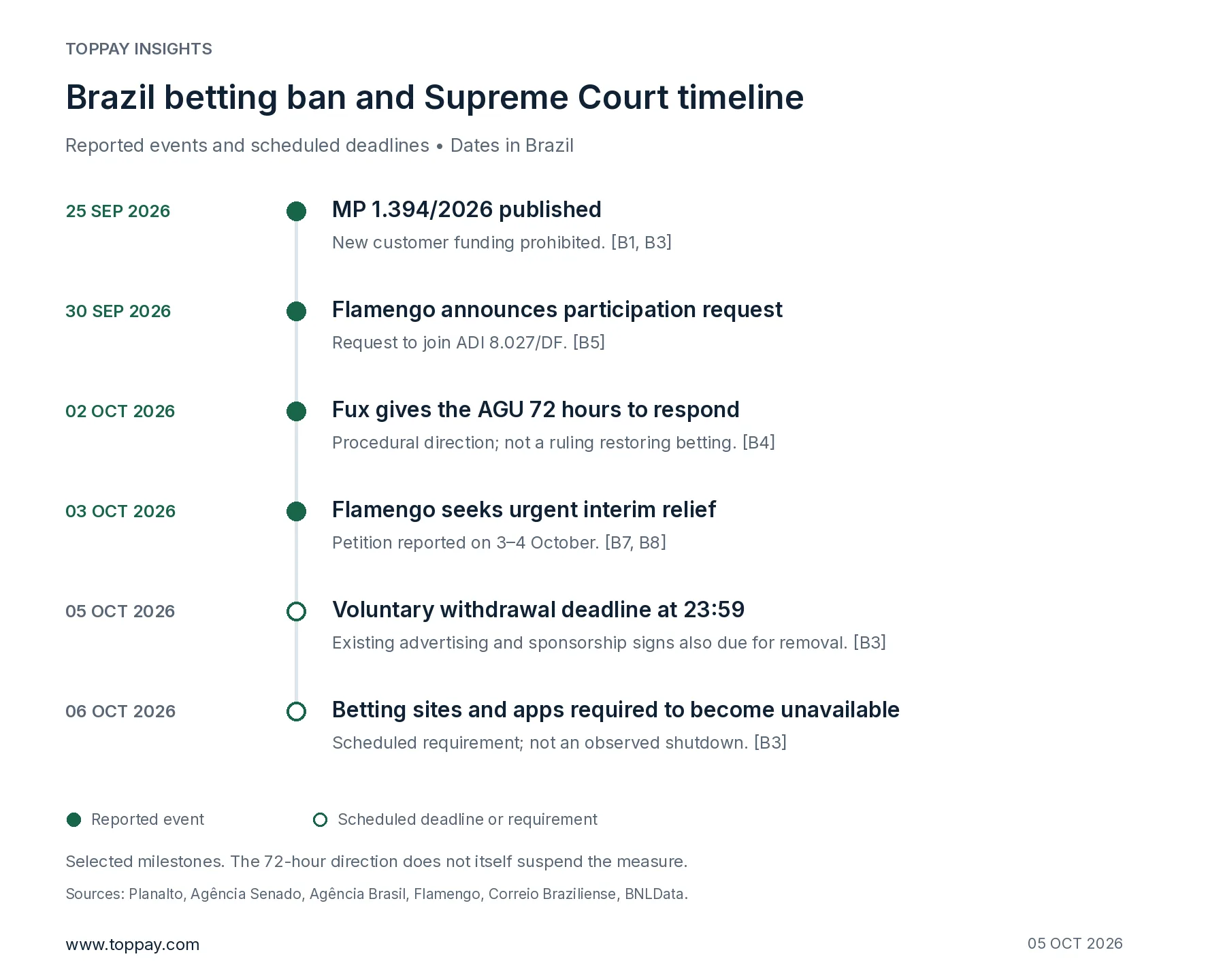
Brazil’s betting dispute has become time sensitive. On 2 October 2026, Supreme Federal Court Justice Luiz Fux gave the Advocacia-Geral da União (AGU), the federal government’s legal representation body, 72 hours to respond to petitions seeking the return of online betting. Agência Brasil reported the direction. [04]
Football clubs are also pressing for relief. Reporting published on 3–4 October says Flamengo requested an urgent ruling on the challenge to the ban before the shutdown deadline. These developments concern submissions and requests; neither establishes that the prohibition has been suspended. [07], [08]
What the measure covers
Medida Provisória (MP) nº 1.394/2026, published on 25 September, prohibits fixed-odds betting on real sporting events and online games. Its scope includes physical and virtual channels, as well as operators based abroad offering bets to people in Brazil. Other lottery categories authorised by law are excluded. Articles 1–2. [01]
The measure also restricts advertising, sponsorship and payment processing. Transactions necessary to close operations and return money to bettors are expressly excepted from the payment prohibition. This exception matters because a refund and a new betting deposit serve different purposes under the measure. Articles 14–17. [01]
Why football clubs joined the case
Flamengo’s own statement on 30 September confirms that it requested admission as amicus curiae, or a friend of the court, in ADI 8.027/DF. The club said it wanted to address existing sponsorship contracts, sports funding and legal certainty. These are the club’s arguments, rather than findings made by the court. [05]
UOL reported on 1 October that São Paulo, Ponte Preta, Vitória, Guarani and Portuguesa SAF submitted a petition after moves by Flamengo and Botafogo. Requests to participate and court decisions admitting participants must be distinguished, particularly because several related cases are involved. [06]
The later Flamengo request, reported on 3–4 October, sought urgent interim relief. It shows the pressure created by the timetable, but it does not establish the outcome of that request. [07], [08]
Verified events and scheduled deadlines
| Date in Brazil | Event or requirement | Evidence and status |
|---|---|---|
| 25 Sep 2026 | MP 1.394/2026 published; new customer funding prohibited. | Primary law and official explanation [01], [03] |
| 30 Sep 2026 | Flamengo announces its request to join ADI 8.027/DF. | Club’s own statement [05] |
| 1 Oct 2026 | Additional clubs submit a petition, according to UOL. | Reported participation requests [06] |
| 2 Oct 2026 | Fux gives the AGU 72 hours to respond. | Reported procedural direction [04] |
| 3 Oct 2026 | Flamengo seeks urgent consideration of interim relief. | Reported on 3–4 Oct; outcome not established [07], [08] |
| 5 Oct 2026 at 23:59 | Deadline for voluntary balance withdrawals and removal of existing advertising and sponsorship signs. | Scheduled deadline in official explanation [03] |
| From 6 Oct 2026 | Betting sites and apps are required to become unavailable. | Scheduled requirement; not an observed shutdown [03] |
| 25 Oct 2026 | Existing betting authorisations are scheduled to be terminated. | Scheduled statutory milestone [01], [03] |
What this means for payment teams
TopPay analysis: the immediate operational issue is the purpose of each transaction. Article 14 separates prohibited betting flows from transactions required for closure and restitution. Payment teams need records that show which activity a transfer supports; an existing integration or commercial contract does not answer that question. [01]
A shutdown also leaves continuing obligations. The measure requires operators to retain records and meet reporting duties relating to their earlier authorised activity. Refund reconciliation and the identification of the account holder therefore remain relevant during closure. Articles 8–11. [01]
Football club appeals illustrate how regulatory change can affect contracts beyond the operator itself. The clubs’ public statements describe contractual concerns and potential financial harm; they should not be treated as audited aggregate losses for Brazilian football.
The next record to watch
The decisive judicial update will be a written court order setting out whether any provision is suspended and the scope of that relief. The parliamentary process is separate: the official record shows the MP under consideration in Congress. A response deadline, a participation request and a final ruling have different legal effects. [02], [04]
Sources
- [01] Presidência da República · 2026-09-25 · B1
- [02] Congresso Nacional · Current record reviewed 2026-10-05 · B2
- [03] Agência Senado · 2026-09-28 · B3
- [04] Agência Brasil · 2026-10-02 · B4
- [05] Clube de Regatas do Flamengo · 2026-09-30 · B5
- [06] UOL · 2026-10-01 · B6
- [07] Correio Braziliense with Agência Estado · 2026-10-03 · B7
- [08] BNLData · 2026-10-04 · B8