Cambodia’s Online Betting Restrictions: Enforcement at 24 Casinos
An official update confirms that 24 casinos ended online gambling and betting after the 30 September deadline. The report also describes separate action against casino licences linked to online scams.
Sources reviewed on 5 October 2026

Cambodia has moved from announcing restrictions to reporting enforcement results. On 1 October 2026, state news agency Agence Kampuchea Presse (AKP) reported that 24 casinos had stopped online gambling and betting after the 30 September deadline. The report cited inspection findings from the Secretariat of the Ad Hoc Commission for Combating Online Scams (CCOS). [01]
For operators and payment providers, the important question is which activity a business actually conducts. The reported cessation concerns online operations at the identified casinos; it should not be described as the closure of every licensed land-based casino in Cambodia.
What the latest official update confirms
The CCOS statement reiterates that online gambling and betting are prohibited both inside and outside casino premises. It identifies gambling livestreams, online football betting and online lotteries among the activities stopped. Asia Gaming Brief reported the same findings on 2 October, citing AKP. [01], [04]
The earlier policy announcement helps explain the timing. On 16 September, BERNAMA-Xinhua reported Prime Minister Hun Manet’s statement that online gambling at land-based casinos would be suspended from early October. He linked the action to technology-based fraud and illicit financial flows. The announcement was a government policy statement, rather than evidence that all premises had already complied. [03]
Separate action against licences linked to scams
AKP’s 8 September report recorded 18 casino licences revoked and nine suspended pending further investigation. It also described cooperation with regulators, judicial authorities and the Cambodia Financial Intelligence Unit on asset seizure, freezing and confiscation measures. The 1 October report repeats the licence figures as of September. [02], [01]
Licence revocation, licence suspension and cessation of online betting are different measures. The material reviewed does not establish whether the 24 casinos overlap with the groups whose licences were revoked or suspended. These counts should therefore not be added into a combined total.
Officially reported figures and their scope
| Measure | Reported figure | Scope and evidence |
|---|---|---|
| Casinos ending online operations | 24 casinos | After the 30 Sep deadline; AKP report dated 1 Oct [01] |
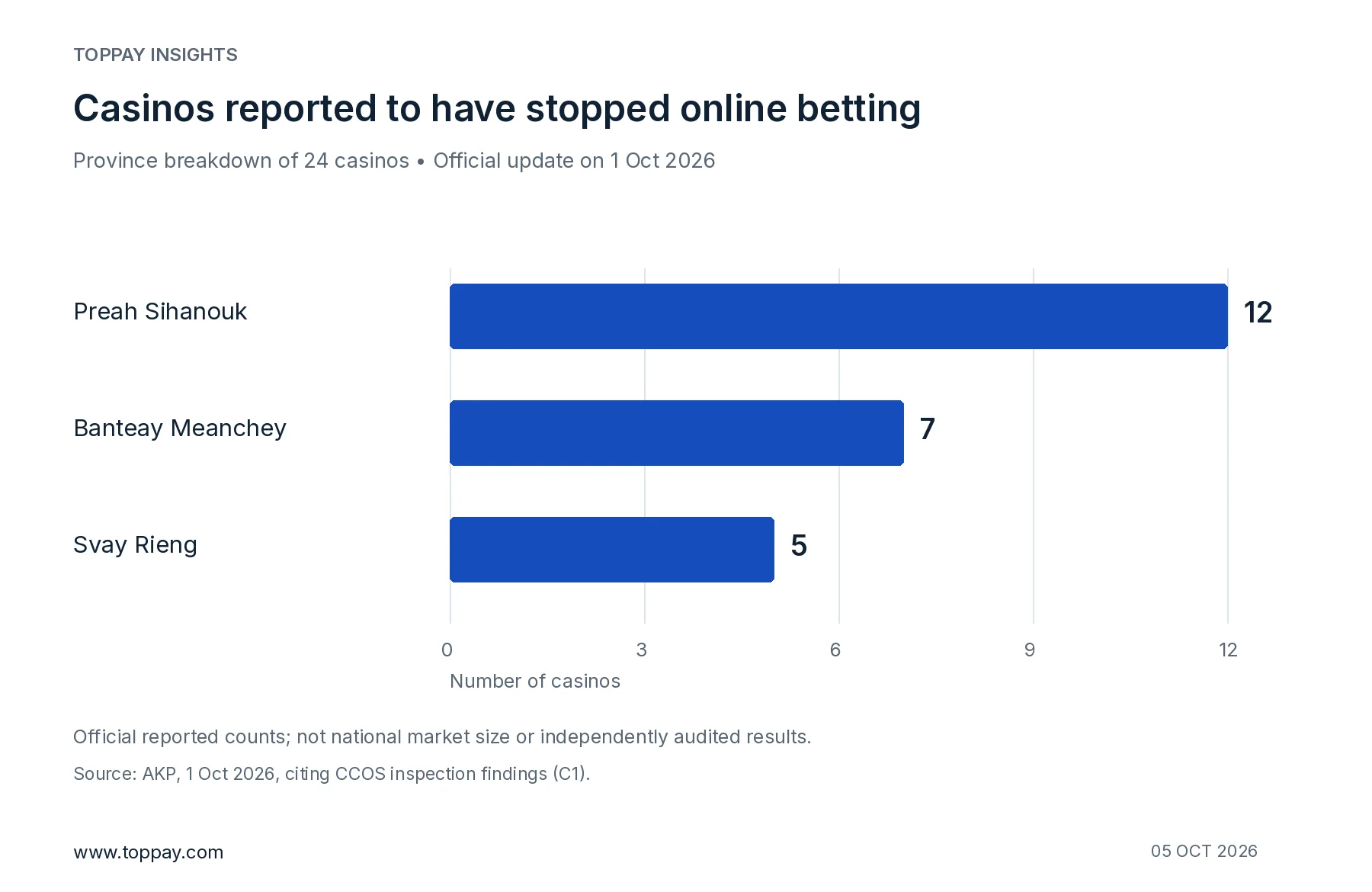
| Preah Sihanouk | 12 casinos | Part of the reported group of 24 [01] |
| Banteay Meanchey | 7 casinos | Part of the reported group of 24 [01] |
| Svay Rieng | 5 casinos | Part of the reported group of 24 [01] |
| Licences revoked over scam links | 18 licences | As of Sep 2026; separate licence measure [02], [01] |
| Licences suspended | 9 licences | Pending further investigation; separate licence measure [02], [01] |
Why the update matters for payments
TopPay analysis: a business’s name, physical address or casino licence alone does not establish that its online activity is permitted. The underlying service and transaction purpose need to match the activity authorised under the applicable rules.
The separate asset measures make ownership and financial relationships relevant to counterparty review. A payment team assessing exposure needs to identify the operating company, beneficial owners and settlement account holder, and understand whether any applicable restriction concerns the business, its assets or a particular activity.
The official report gives a useful view of enforcement at identified locations. It does not provide a national compliance rate or prove that online scam networks have been eliminated. Online betting restrictions and action against suspected scam operations should be described separately.
What would clarify the next stage
Further official inspections, changes to licence status and published rules defining permitted activity would be the most useful records to follow. For a payment provider, those documents are more informative than a general claim that a venue remains open or holds a commercial licence.