Instant Is Not a Payment Method
UPI, QRIS, PromptPay and GCash can all feel fast to the customer. Underneath, they are very different payment models.
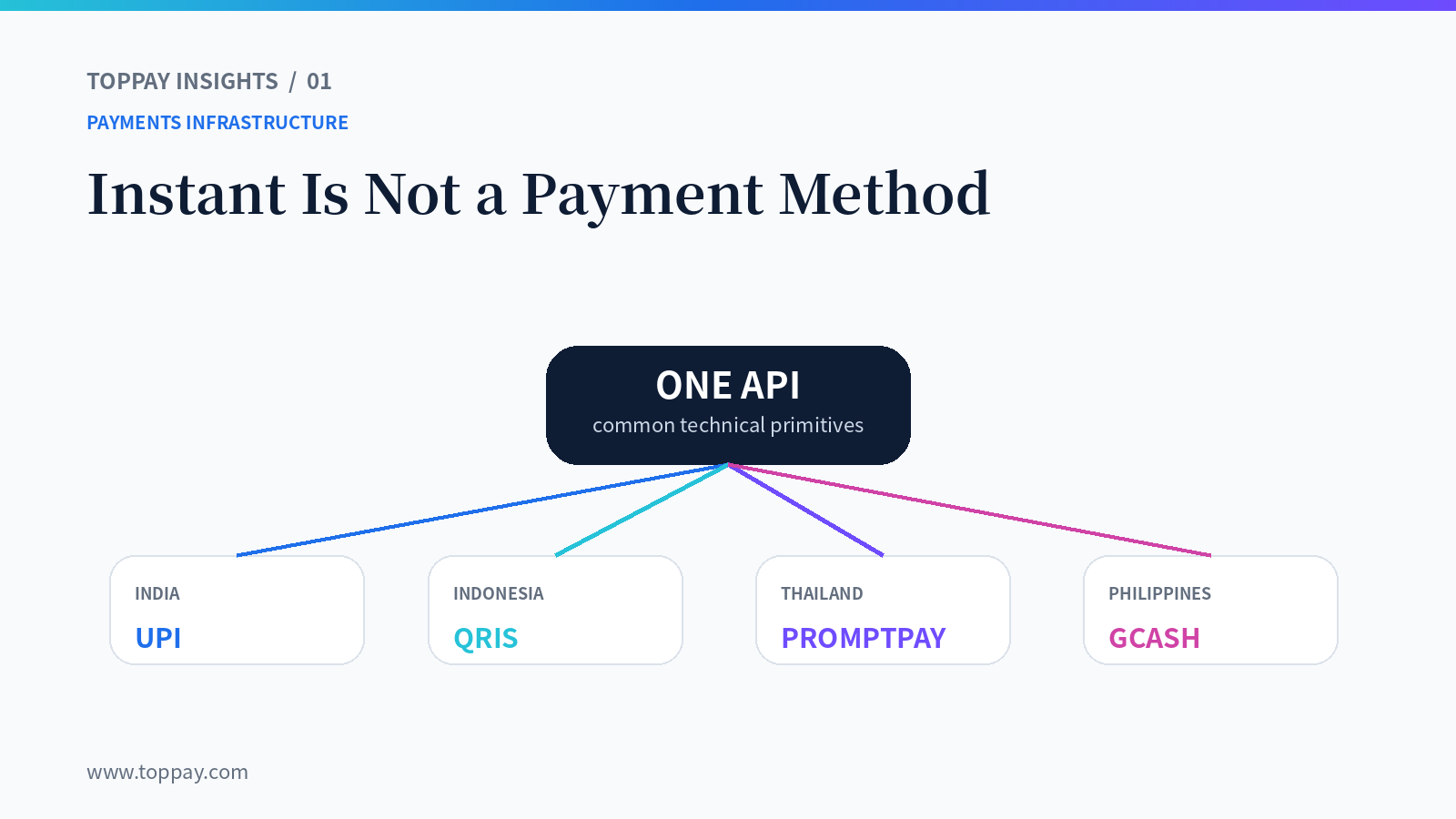
The payments industry often groups very different systems under one convenient word: instant. India has UPI. Indonesia has QRIS and BI-FAST. Thailand has PromptPay. In the Philippines, millions of consumers experience digital payments through GCash. From the customer’s point of view, all four can make paying feel fast and familiar.
But they are not four versions of the same infrastructure. UPI is an interoperable account-to-account system. QRIS is a national QR standard used across participating providers. PromptPay is an instant-transfer service built around bank accounts and easy-to-remember identifiers. GCash is a mobile wallet and broader financial-services ecosystem.
Speed can look similar at checkout. The infrastructure underneath can be completely different.
Scale shows that local payment behaviour is now core infrastructure
NPCI recorded 24.51 billion UPI transactions in August 2026, with 752 banks live on UPI. Bank Indonesia reported 65.77 million QRIS users and 44.86 million merchants by June 2026, with 12.55 billion QRIS transactions in the first half of the year. Bank of Thailand recorded 2.534 billion PromptPay transactions in June 2026. GCash, in company-reported figures on its official site, says 94 million Filipinos have used the app and lists 6 million merchants and social sellers.
These figures are not directly comparable. They measure different things, over different periods, across different payment models. What they show together is more useful: local payment behaviour is no longer a secondary checkout preference. It is part of the financial infrastructure customers use every day.
India: the account is underneath; the app is what the customer experiences
UPI separates the payment rail from the interface the customer sees. A shopper may pay through a bank app, a third-party UPI app, a QR code or an intent flow. To the customer, the app or QR journey is the payment. Underneath it sits interoperable account-to-account infrastructure.
For an international merchant, the useful question is therefore not simply “Do we support bank transfer?” It is “Can the customer start, approve and complete the payment in the way they already expect?” That includes app switching, confirmation, recovery after an interrupted session and clear handling of unresolved states.
Indonesia: one QR standard does not mean one operational model
QRIS standardizes the customer-facing QR layer across participating banks and e-wallets. That makes acceptance easier to understand, but it does not remove the operational work behind payment creation, transaction references, notifications, reconciliation and settlement.
A QR code can make checkout look simple. The infrastructure behind it rarely is.
Thailand: the identifier is part of the payment experience
PromptPay supports identifiers such as mobile numbers, national ID numbers, corporate tax numbers, e-wallet numbers and traditional bank accounts. The information people naturally associate with sending and receiving money changes how intuitive a payment or payout flow feels.
Localization therefore happens in the data model as well as on the checkout screen. A product designed around one country’s account format will not automatically feel local somewhere else.
The Philippines: sometimes the wallet is the customer’s payment world
GCash illustrates a different model again. The app combines wallet payments with transfers, bill payments, merchant purchases and access to other financial services. For many customers, the payment experience begins and ends inside the wallet, even when the underlying movement of funds may involve broader banking and payment infrastructure.
For merchants, that means supporting the market is not only about connecting a rail. It is also about fitting the app, wallet and QR behaviour that customers already recognize.
One API should standardize infrastructure - not erase local behaviour
A strong payment-orchestration layer can normalize authentication, API structure, transaction identifiers, idempotency, signed callbacks, status queries and reconciliation output. It should not force every market into an identical customer journey.
The API can be global. The payment experience should remain local.
What merchants should ask before opening another market
Before approving a new payment method, follow the transaction from the moment the customer presses Pay to the moment finance can confidently close the ledger. How is the payment initiated? Does the customer scan, redirect, approve in another app or pay from a wallet? How long can the status remain unresolved? Which notification is authoritative? How does the transaction appear in settlement? If money needs to move back out, does the payout flow behave just as predictably?
Speed is becoming standard. Behaviour is staying local.