The Local Rails Index: What 2026 Payment Data Is Telling Merchants
Across major digital-payment markets, local rails are no longer “alternative”. They are part of the core payment stack.
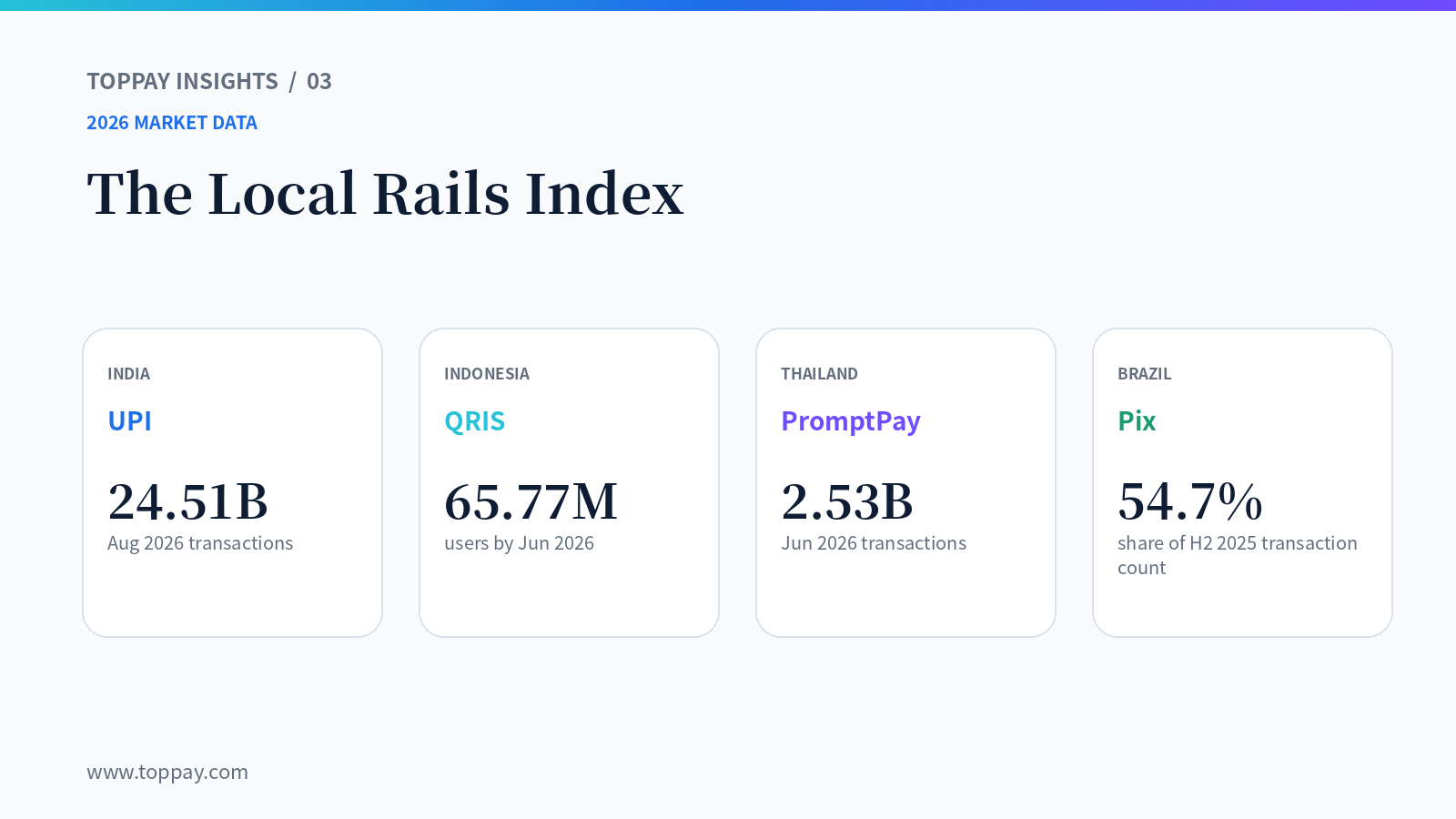
For years, local payment methods were presented as an addition to the international card stack: something to enable after launch, something that might improve conversion, something “alternative”. Official data from India, Indonesia, Thailand and Brazil points to a different reality.
In many markets, local rails are no longer an alternative to the payment stack. They are part of the payment stack.
India - UPI: 24.51 billion transactions in one month
NPCI recorded 24.51 billion UPI transactions in August 2026, up from 23.66 billion in July and 22.72 billion in June. August transaction value was approximately INR29.82 trillion, with 752 banks live on UPI.
The important signal is not only scale. Once an interoperable rail is embedded across banking and consumer-payment apps, it stops behaving like an optional feature and becomes part of how customers understand digital money.
Indonesia - QRIS: adoption is growing on both sides of the transaction
By June 2026, Bank Indonesia reported 65.77 million QRIS users and 44.86 million merchants. QRIS processed 12.55 billion transactions worth Rp1.12 quadrillion in the first half of 2026, and 96.68% of QRIS merchants were MSMEs.
The merchant figure matters because payment networks become more useful when consumer adoption and acceptance grow together. QRIS is not simply an online checkout option; it is part of Indonesia’s broader acceptance infrastructure.
Thailand - PromptPay: operating at everyday-payment scale
Bank of Thailand recorded 2.534 billion PromptPay transactions in June 2026, with a value of THB4.603 trillion. The service supports mobile numbers, national ID numbers, corporate tax numbers, e-wallet numbers and bank accounts as identifiers.
For merchants, the lesson is that localization is partly interface design and partly data architecture. The information customers naturally associate with sending or receiving money differs from market to market.
Brazil - Pix: beyond the “alternative payment” label
Banco Central do Brasil reported 42.9 billion Pix transactions in the second half of 2025, equal to 54.7% of payment transaction count during that period. Cards collectively represented 30.4% of transaction count.
At that scale, calling Pix an “alternative” misses the point. For merchants entering Brazil, local account-to-account acceptance is part of mainstream payment behaviour.
Four systems, one direction - but not one metric
These figures should not be turned into a simple ranking. Reporting periods differ, transaction definitions differ and market structures differ. The common signal is more important: domestic instant and QR-based payment systems have moved from experimentation into infrastructure.
The next competitive advantage is not simply coverage
A PSP can display dozens of payment-method logos. That shows what is technically connected. It does not show whether the customer flow feels local, whether status handling is reliable, whether reconciliation is clear, whether payouts are equally well supported, or whether merchant eligibility is continuously monitored.
Coverage is the starting point. Operational depth is what turns coverage into a reliable product.
Local does not have to mean fragmented
Global payments contains an apparent contradiction: customers increasingly expect local payment experiences while merchants want fewer integrations. Both can be true. The infrastructure layer can consolidate while the customer-facing layer remains local.
That is the practical value of one integration: not one identical payment experience everywhere, but one technical connection underneath many local behaviours.